
How the Fourth Amendment Right Helps Your Criminal Case
If you were arrested in Tampa, the outcome of your case may depend on what evidence the State can use against you. But not all evidence is admissible in court—especially if it was obtained in violation of your Fourth Amendment rights. This crucial constitutional protection can mean the difference between a conviction and a dismissal.
At Brett Metcalf, Criminal Defense Attorneys, P.A., we fight to ensure law enforcement follows the Constitution. Here’s how the Fourth Amendment protects you and how it can help your defense.
What the Fourth Amendment Says
The Fourth Amendment to the U.S. Constitution guarantees that:
“The right of the people to be secure in their persons, houses, papers, and effects, against unreasonable searches and seizures, shall not be violated, and no Warrants shall issue, but upon probable cause…”
This means police cannot search you, your car, your home, or your belongings without a valid reason. Generally, officers must obtain a warrant supported by probable cause and must describe exactly what they are searching for.
In Florida, this right plays out daily in traffic stops, home searches, and arrests. When police skip the warrant or overstep their authority, the evidence they seize may not be allowed in court.
The Exclusionary Rule and the “Fruit of the Poisonous Tree”
The U.S. Supreme Court created the exclusionary rule to enforce the Fourth Amendment. It prevents prosecutors from using evidence obtained through illegal searches or seizures.
If police violate your rights, the evidence they collect—like drugs, weapons, or statements—may be suppressed, or “thrown out.” Courts also exclude anything that results from that illegal search, known as the “fruit of the poisonous tree.”
For example, if officers illegally search your car and find a weapon, and that discovery leads to your confession, both the weapon and your statement could be inadmissible.
Common Exceptions to the Warrant Requirement
There are a few limited circumstances when police can search without a warrant. These include:
- Search incident to a lawful arrest: Officers may search you and the immediate area around you when you’re lawfully arrested.
- Plain view: If officers lawfully enter a space and see evidence in plain sight, they can seize it.
- Consent: If you voluntarily agree to a search, officers don’t need a warrant—but that consent must be freely given.
- Good faith: If police rely on a warrant they reasonably believe is valid, even if later found defective, evidence may still be used.
- Exigent circumstances: In emergencies, such as when evidence may be destroyed or someone is in danger, officers may act without a warrant.
A skilled defense attorney will examine whether these exceptions apply—or if police went too far.
When Fourth Amendment Violations Arise in Florida Cases
Violations can happen in many types of cases. Common examples include:
Traffic Stops and Vehicle Searches
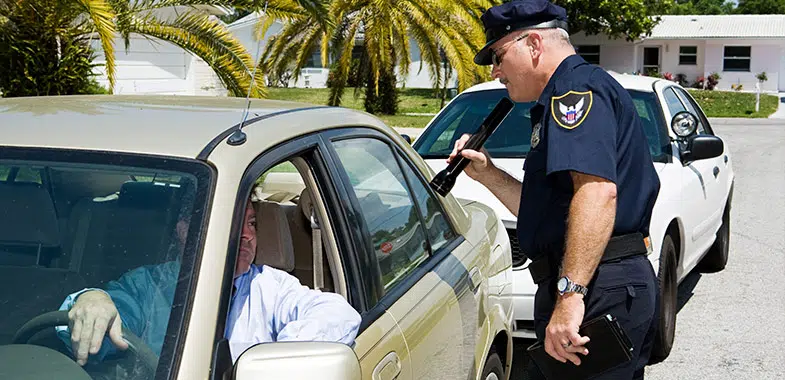
Police must have reasonable suspicion to stop a car and probable cause to search it. Prolonging a stop for a drug-sniffing dog or searching without justification can violate your rights.
Home and Apartment Searches
Entering your home without a warrant or valid consent is generally unconstitutional. Even with a warrant, police must follow strict rules about where and what they can search.
Stops and Frisks
Under Terry v. Ohio, officers may pat you down for weapons only if they reasonably believe you are armed and dangerous. A “hunch” is not enough.
Digital Devices and Cell Phones
Florida law enforcement agencies have used tools like “stingray” devices to track cell phones. Without a warrant, this can amount to illegal surveillance. Your cell phone data, messages, or location history are protected by the Fourth Amendment.
How Fourth Amendment Issues Affect Evidence in Your Case
When evidence is obtained illegally, it can’t be used in court. That means the prosecution’s case may fall apart if key evidence—like drugs, weapons, or statements—is suppressed.
Even if some evidence remains, suppressing critical pieces can lead to reduced charges, better plea deals, or a complete dismissal.
How a Tampa Criminal Defense Attorney Uses the Fourth Amendment
At Brett Metcalf, we analyze every detail of your arrest to uncover constitutional violations. Here’s how we approach it:
- Investigate the Stop or Search – We review reports, body-cam footage, warrants, and police procedures.
- Challenge Probable Cause – We question whether officers truly had a legal reason to stop or search you.
- File Motions to Suppress – We ask the court to exclude illegally obtained evidence before trial.
- Argue Exceptions Don’t Apply – We show that “consent,” “good faith,” or “plain view” exceptions were misused.
- Leverage Suppression for Results – If key evidence is suppressed, we push for dismissal or a favorable plea.
Real-World Example of 4th Amendment Violations
Imagine police stop you for a broken taillight, then search your car without your permission and find drugs. If there was no probable cause for that search, we can move to suppress the drugs as evidence. Without it, the prosecution’s case may collapse.
The same principle applies if your phone was searched without a warrant or your home was entered without legal justification.
Could a Fourth Amendment Violation Apply to Your Case?
Ask yourself:
- Did the police have a warrant?
- Did you consent to a search, or did you feel pressured?
- Did officers search areas or devices not listed in the warrant?
- Did a stop last longer than necessary?
If any of these sound familiar, your rights may have been violated.
FAQs About Fourth Amendment Rights in Tampa Criminal Cases
Can the police search my trash or property outside my home without a warrant?
Yes — but only under certain conditions. The U.S. Supreme Court has ruled that trash left outside the “curtilage” of your home (like at the curb for pickup) is not protected by the Fourth Amendment. However, if police have to enter fenced or private areas to access it, that could violate your rights.
What happens if I didn’t realize I could refuse a search?
Even if you didn’t know you could refuse, your attorney can still challenge whether your “consent” was truly voluntary. Courts look at the totality of the circumstances—how many officers were present, what they said, and whether you felt free to leave. If the consent wasn’t genuine, any evidence may be suppressed.
Can the police track my location using GPS or phone data without a warrant?
Generally, no. In Carpenter v. United States, the Supreme Court ruled that accessing historical cell-site data counts as a search under the Fourth Amendment. That means law enforcement usually needs a warrant to obtain your phone’s location history or similar tracking information.
Does the Fourth Amendment protect me from searches by private security or employers?
Not always. The Fourth Amendment restricts government actors—like police and other public officials—not private individuals. However, if private security is working directly with or under the direction of law enforcement, constitutional protections may still apply.
What if police used a drug-sniffing dog near my home or vehicle?
A dog sniff around your car during a lawful traffic stop is sometimes allowed. But using a trained K-9 to investigate your home or porch without a warrant is considered a “search” and is usually unconstitutional, as established in Florida v. Jardines. Your attorney can determine if the use of a dog went beyond what the law allows.
If my rights were violated, will my entire case be dismissed automatically?
Not necessarily. A successful suppression motion can exclude illegally obtained evidence, but prosecutors may still proceed with any remaining admissible evidence. However, if that evidence is central to the case—like drugs, weapons, or a confession—the State’s case often weakens dramatically.
Can juveniles be searched without a warrant?
Only in certain circumstances can juveniles be searched without a warrant. They can agree to the search or if police believe there is a risk to the public or that evidence will be destroyed. A law enforcement officer can also search a juvenile if there is an illegal object in plain view.
What should I do if I think police searched me illegally?
Write down everything you remember about the encounter—what the officers said, whether they showed a warrant, and what they seized. Then contact a Tampa criminal defense attorney immediately. Quick action helps preserve surveillance footage, dispatch logs, and other evidence that can prove your Fourth Amendment rights were violated.
Call a Tampa Criminal Defense Attorney Today
A Fourth Amendment violation could change the outcome of your case—but timing matters. Evidence must be preserved, and motions to suppress must be filed early.
At Brett Metcalf, Criminal Defense Attorneys, P.A., we’ve successfully challenged unconstitutional searches and seizures across Tampa and Hillsborough County. We know how to protect your rights and fight back when law enforcement crosses the line.
Call (813) 258-4800 or contact us online today for a free, confidential consultation.